On October 29, Wisconsin Family Action’s Legislative Director, Sam Krebs, presented before the Speaker’s Taskforce on Protecting Kids about the importance of family for child wellbeing. The focus of this taskforce is preparing parents and protecting kids in a digital age. No doubt rapidly changing technology and the world at their fingertips through the internet and social media has introduced perils to innocent children.
The purpose of the taskforce is to consult experts and knowledgeable individuals about the topic of protecting kids from digital threats and then to recommend legislation to the Assembly in the spring. The eight-member taskforce is chaired by freshman Rep. Lindee Brill from Sheboygan Falls.
Starting in the Home
While some might expect this taskforce to introduce legislation that enforces digital protections for children, Wisconsin Family Action believes that any taskforce looking at protecting children must start in the home. That’s why we shared that children more than anyone else pay for the breakdown in marriages and the fragmenting of families and urged policymakers to prioritize the family rather than undermine it. The safety of children begins with stabilizing the home.
At this hearing, Krebs urged lawmakers to look long term – to consider the effect each piece of legislation will have on the nuclear family. Just as a mountain cannot be climbed in a single leap, making Wisconsin a family-first state will require years of focus, consistent emphasis, and buy-in from leaders across society and government.
Most of Wisconsin’s difficult issues can be traced back to the denigration of marriages and families. The scars of broken families are seen all over the state from deepened bonds of addiction, to near record low education scores, to higher levels of crime.
The Importance of Marriage
Good marriages and strong families are the foundation of a successful community. Yet for decades, society has steadily and intentionally moved away from the very core principles that once underpinned our success.
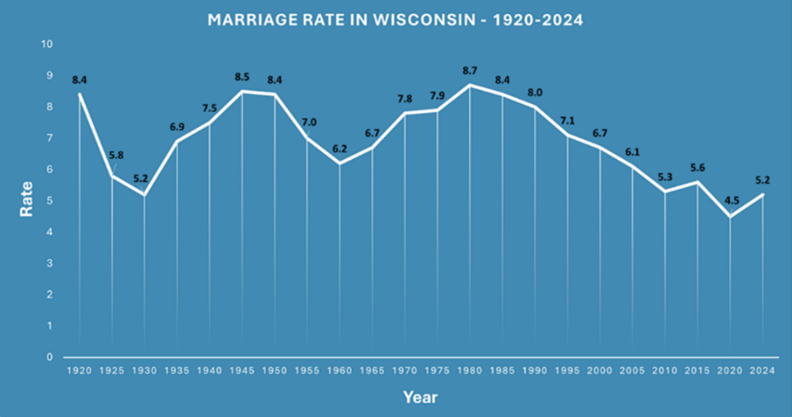
Over the past 50 years, Wisconsin has experienced a notable decline in marriage rates not seen since the Great Depression. The statistics tell a stark story. Between 1990 and 2024, Wisconsin’s marriage rate fell from 8.0 to 5.2 per 1,000 residents—a devastating 35% decline.
Marriage delivers irreplaceable benefits to society that no other relationship or social institution can match.
Most importantly, marriage has a measurable benefit on child development outcomes. The single most reliable indicator of children’s long-term success is being raised by married, biological parents. Nothing else comes close.
Children raised by their married, biological parents are more likely to:
- Flourish in school, graduate from high school, and attend college
- Move up the income ladder
- Learn self-control, conflict resolution, and trustworthiness
- Pass down these character traits to future generations
The bottom line is that healthy marriages are critical to a functional society and to the benefit of our children. If policy makers would like to reduce poverty, lower physical and emotional health problems (in children and adults), decrease child abuse, and lessen youth delinquency, then strong marriages are the first and best solution.
Wisconsin's Family Structure by the Numbers
The Family Structure Index is a statistical ranking tool which evaluates the share of adult residents of a state who are married, have children, and raise those children together through the child’s high-school years. Essentially, the better a state scores on the Index, the more likely a state as whole is to have strong families.
The Family Structure Index showed the following in Wisconsin :
- Only 56.9% of adults aged 25 to 54 in Wisconsin are married.
- The average number of lifetime births per woman in Wisconsin is just 1.65, well below the replacement fertility rate of 2.1.
- Only 56% of children in Wisconsin live with their married birth or adoptive parents at ages 15 to 17, meaning that 44% of teenagers in Wisconsin are raised in broken or never-formed family situations.
These less-than-ideal statistics place Wisconsin in the middle of the Family Structure Index. Because policymakers must care about marriage and good marriages as the foundation of families in the best interests of children, they must also care about non-married relationships.
To be clear, our goal in raising these concerns is not to pass judgment on different family configurations, but rather to recognize a practical reality. We must acknowledge that family structure matters fundamentally, not just circumstantially. While many single parents demonstrate extraordinary commitment and sacrifice, the structural reality remains: one person cannot fulfill all the complementary roles and responsibilities that a mother and father provide together.
In 2012, Ron Haskins—an expert in welfare reform, child care, child support, and marriage—noted:
Many of the problems we associate with failures of American economic policy — especially the persistence of a high poverty rate despite the billions of dollars a year we spend on relief efforts — can also be attributed to family breakdown. Indeed, it is not an exaggeration to say that America’s social problems and its economic problems are thoroughly intertwined with the decline of marriage and the rise of single parenting.
Divorce and Failing Marriages Bring Steep Consequences.
When marriages fail, the fracture lines run deep through childhoods, across communities, and into the next generation. A large, 50-year study tracking over 1 million children found that parental divorce is linked to sizable, long-term harms for children including:
- 60% higher risk of teen pregnancy
- 40% higher risk of jail time
- 45% higher risk of early death
- 9–13% lower adult wages
- Lower chances of going to college
Beyond these measurable outcomes, divorce often involves substantial emotional stress and family instability. Divorce isn’t just a decision between adults; it’s a life-altering event for children with real, lasting trauma.
The Impact of Single Parenting
There are also consequences of not forming marriages at all and choosing single parenting as a lifestyle.
Ron Haskins’s comprehensive review of decades of research documents the cumulative disadvantages children face when raised outside intact marriages :
- Heightened risks of delinquency
- Reduced high school and college completion rates
- Higher early pregnancy rates for girls
- Significantly higher incarceration rates for boys
- Substantially elevated poverty levels throughout their lives
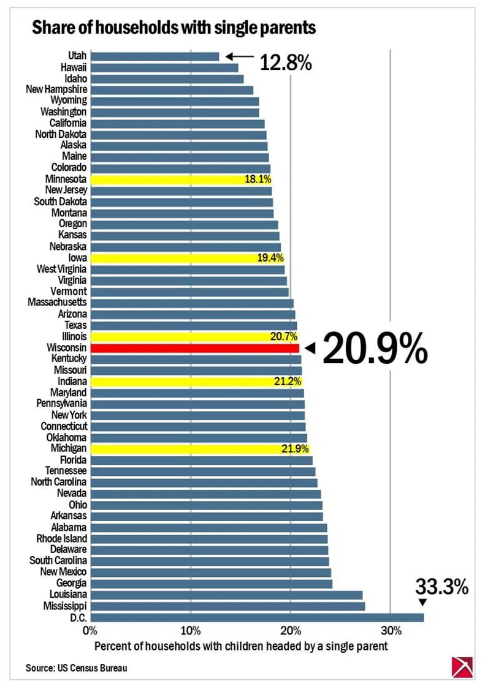
Looking at the numbers, children in single-parent households face four to five times higher rates of poverty compared to children in two-parent families.
Healthy Families: A Necessity
Given this overwhelming evidence, the question isn’t whether Wisconsin can afford to support marriage and family formation—it’s whether we can afford the generational costs of ignoring what research makes unmistakably clear. Every policy choice either strengthens or weakens family formation and as a result keeping our kids safe. Wisconsin must deliberately choose families first.
Wisconsin’s approach to family-first policy must acknowledge the powerful intersection of faith in God and family stability in producing positive social outcomes.
Ultimately, every proposal and policy idea has built-in limitations because character cannot be legislated. Without virtue rooted in faith in God, our efforts can only address symptoms, not causes. A return to faith isn’t just helpful—it’s the foundational element upon which all other solutions this taskforce investigates will depend.
If this taskforce truly wants to protect children, it must start at the critical point where success or failure in life is most often determined.
Potential Solutions for Strengthening Wisconsin Families
Some potential avenues to strengthening Wisconsin families include:
- Teaching future generations basic principles for making wise decisions early in life
- Reducing barriers to marriage and incentivizing healthy relationship habits
- Using tax policy to work for not against families
- Finding solutions to the growing technology crisis
- Establishing a permanent focus on improving Wisconsin’s family outcomes
Wisconsin’s path stands at a crossroads. We can continue down the road of family fragmentation, accepting the enormous social and economic costs of broken homes, educational failure, and community dysfunction. Or, we can choose a different direction—one that recognizes family formation as the foundation upon which all other policy success depends.
The evidence is clear. Strong marriages and intact families provide irreplaceable benefits to society. Children raised by their married, biological parents consistently outperform their peers across every meaningful measure of wellbeing.
Communities with higher concentrations of married families show lower crime rates, better educational outcomes, and greater economic prosperity. Family matters.
With declining marriage rates and nearly half of Wisconsin teenagers growing up in broken or never-formed families, Wisconsin needs a dramatic, sustained turnaround now. Achieving a family-first Wisconsin will take an all-hands approach and priority change in the minds of our leaders. We hope the Taskforce on Protecting Kids will take this challenge seriously.
The work of Wisconsin Family Action is possible because of generous friends who partner with us financially and in prayer. If you value the work WFA does, we invite you to invest in this unique work that is all about you, your family, your faith, your freedom, and your future! As always, we welcome and covet your prayers.
